I build API integrations and automation: I connect the tools a company already uses, like payments, accounting, banking and management software, and remove the work someone does by hand today, copying data from one place to another.
AI automations that handle the repetitive work on their own, like reading documents, filling in data and drafting replies, and ask you to confirm before anything important.
The backend that holds it all together, on AWS or Firebase, with an alert when something goes wrong.
How I approach an integration
It starts with a mapping session: two hours together to find out where time is lost today and who does what by hand, followed by a written plan of what to automate and in what order. We start with the piece that pays off most, not with everything at once.
Every integration has a test environment, a log of what goes through it and an alert when a call fails. So you see a problem right away, not a week later.
An agent that decides on its own? No
Nobody wants an automation that spends money or sends messages without asking. The ones I build handle the repetitive part on their own and stop to ask before the part that can do damage. And every step is logged, so you can always see what it did.
Where I've done it
Lumideo
In-app subscriptions on iOS and Android, notifications, and cloud functions that do their job on their own when the day comes to open a video.
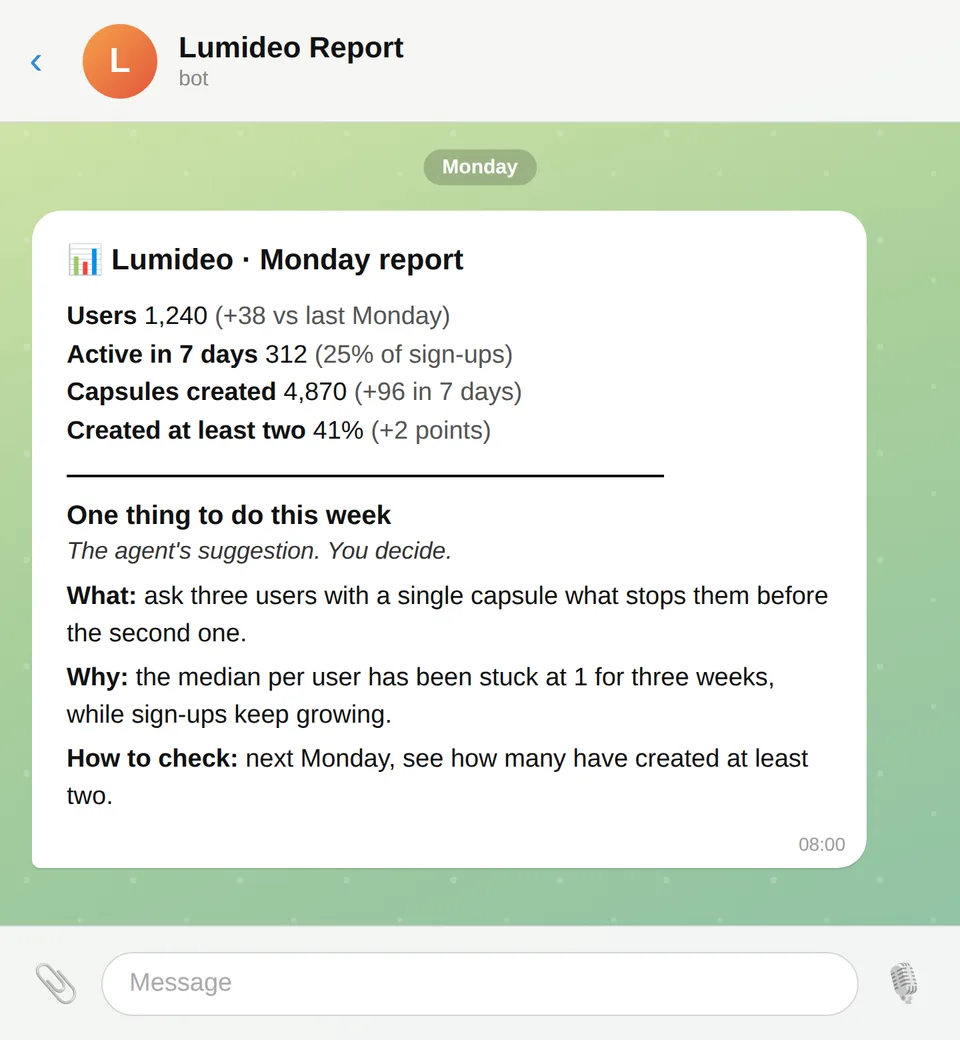
Every Monday an automation reads Lumideo's numbers, writes the report and sends it to me on Telegram. At the end an agent suggests one thing to do that week, with the reason and how to check it. It only suggests: I decide.
What the message looks like. The numbers are examples.
My work dashboard
Since July 27 I run my work from a dashboard I built myself. Tasks are written as decisions, with the reason inside, and Claude keeps it updated with the rules I gave it. At the top there's a counter: it doesn't count closed tasks, it counts real conversations with people.
When I joined there was little more than a draft. I built the foundations of the platform: the serverless backend on AWS, the internal management tool and the automations that handle the paperwork on their own, with integrations for payments, accounting and banking.
Don Gaitano
OpenAI and ElevenLabs inside an app: text and voice generated for every request.
Node.js and TypeScript, AWS (Lambda, API Gateway, DynamoDB, S3, queues and events), Firebase, Python, n8n. REST APIs, and SOAP when needed. Services I have already worked with: Stripe, RevenueCat and App Store and Google Play in-app purchases, QuickBooks, Qonto, Twilio, Aircall, Zendesk, Respond.io, Monday, Resend, Telegram, Google Maps, OpenAI, Claude, Gemini, ElevenLabs, and public administration portals.
Is there a task that eats hours of your week?
Tell me where the time goes. In the first call we work out whether it makes sense to start with a mapping session.
Opens my calendar on Cal.com. Or write to me with the form.
The questions you're asking yourself
I reply within 24 hours. When I start a project, I see it through. Whether I'm in Naples, Mexico or Japan, I work on European hours and I reply within 24 hours. You know this before we start, not after.
It's yours from day one. The code on GitHub, server access, every project document: shared with you from minute zero. Not on delivery, right away. Which means the work carries on without me.
The price doesn't move. Once agreed, the price stays. Even if I got the hours wrong: my mistake, my cost. It changes only if what needs building changes, and in that case you hear it from me first, not on the invoice.
You're buying a date, not a file. A delivery date and something running in production. Not a file, not a zip: on the day I told you, it's live and you're using it. And from then on it's yours, because you've had it since day one.